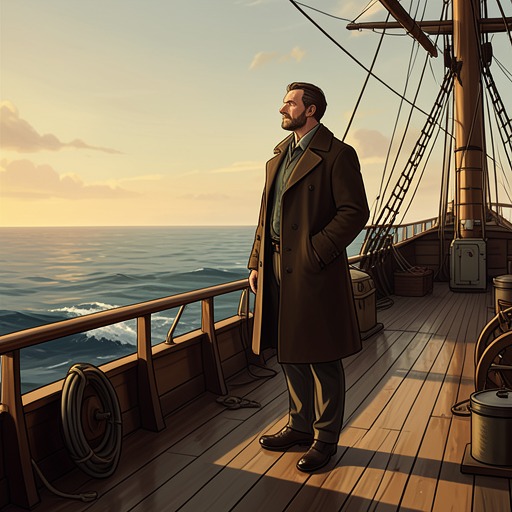
William Scoresby Sr.
The WhaleWilliam Scoresby Sr. is presented as both an exceptionally accomplished whaling captain and an emblem of the confidence with which nineteenth-century whalers claimed the Arctic and its whales. Captured as a young sailor, he escaped and built a career marked by large catches, technological ingenuity and exploration. He treated the taking of whales as an expression of human skill sanctioned by divine order, a conviction that lends his achievements a moral certainty the narrative leaves open to question. His life ends far from the sea, in retirement at Whitby, under circumstances whose cause remains unknown.
From captivity to command
As a young sailor, Scoresby was captured off Trafalgar. He escaped his Spanish captors by stowing away aboard a British ship involved in an exchange of prisoners of war. The episode begins his career with a reversal: a sailor deprived of his freedom returns to the sea and rises through its ranks. Back in Whitby, he joined the whale-ship Henrietta, quickly becoming Specksioneer, or principal harpooner, and then captain.
The account measures the consequences of that ascent in lives taken. Scoresby’s career, it states, claimed 533 whales. His second voyage as master of the Henrietta brought eighteen Greenland whales; during the following five years, the ship caught eighty more, producing nearly 800 tons of oil. These figures give his success a concrete scale: command meant not merely navigating and directing a crew, but turning encounters with enormous animals into a substantial cargo of oil.
A captain in the Arctic
Scoresby’s next command, the larger Dundee, extended that record. On her first voyage she took thirty-six whales, an unprecedented catch. The ship’s reputation was also shaped by a confrontation off the Yorkshire coast, where a French warship threatened her. The Dundee revealed her eighteen-pound guns, and the opposing vessel withdrew. In the narrative, the episode places the whaling ship at the intersection of commercial enterprise and armed danger: its capacity to harvest whales did not make it defenseless against human rivals.
In 1803 Scoresby took command of the Resolution, a new double-hulled vessel with metal plating at the bow to help it push through Arctic ice. His fourteen-year-old son, also named William, sailed with him. The voyage joined a family succession to the practical demands of exploration: the younger William entered the whaling world under the example of a father whose career already combined command and Arctic experience.
Scoresby Sr. had come close to winning a £1,000 prize offered to anyone who could sail north of the eighty-ninth parallel in pursuit of the North-West Passage. The search also opened access to the regions where whales were found. His exploration therefore did not stand apart from whaling: the same movement into Arctic waters served the ambitions of discovery and the business of finding the animals on which the trade depended.
Invention, habits, and public reputation
Among Scoresby’s practical inventions was an enclosed crow’s nest, a protective structure of leather or canvas with room for a telescope and firearm. It also carried flags and a speaking trumpet, allowing communication with the crew or other ships. The device made observation and signaling safer and more organized in exposed waters. Ishmael treats it differently, satirizing Scoresby as Captain Sleet in a contraption armed with a rifle for shooting stray narwhals. The contrast is revealing: a working instrument of Arctic navigation becomes, in the novel’s account, an occasion for comic exaggeration.
Scoresby’s character is conveyed through details that complicate the image of the hard-driving captain. He sometimes wrote his ship’s log in verse, recording the change from western ice to pleasant weather. He also kept a pet polar bear, which he walked on a leash to Whitby harbour to fish for its lunch. Such episodes make him an individual presence within the account of an industry otherwise measured by ships, catches and oil. They do not diminish the scale of his whaling; they show how a distinctive personal life could accompany a career at the centre of the trade.
By the summer of 1817, newspapers were carrying reports from ports across Britain as whaling ships returned laden with blubber and bone. Scoresby presided over what the narrative identifies as the peak years of British whaling and became a representative figure of that national harvest. His record thus belongs to a larger pattern: the voyages that made individual captains celebrated also brought the products of whale deaths into British ports and commerce.
Belief, retirement, and death
Scoresby retired to Whitby in 1823 after a long and successful career. He had not questioned humanity’s right to kill whales. Instead, he understood whaling as a tribute to human ingenuity and divine grace, reasoning that the largest animals were made subject to human use. He described the capture of a whale as a remarkable achievement because an animal vastly larger than a person could be forced to yield its life and carcass. In his account of the practice, commercial extraction and religious belief reinforce one another: the whale’s death appears not as a moral problem but as evidence of human enterprise within a divinely ordered world.
The narrative sets that certainty beside the number of whales he killed without claiming that he later regretted it. On 28 April 1829, at sixty-nine, Scoresby died by suicide at his Georgian house on Bagdale in Whitby. The inquest found that he had been in a state of temporary derangement for several months. The cause of his death cannot be known from the evidence presented, and the account specifically resists turning it into a story of guilt over the whales he had killed. That restraint leaves a stark contrast rather than a tidy explanation: the captain who had interpreted the whale harvest as a sign of human privilege met an unexplained end in the town to which he had retired.